

More Than Just Side Dishes – The Colorful World of Banchan
There is a common “pleasant bewilderment” shared by many travelers visiting a Korean restaurant for the first time. Right after placing an order, a flurry of small, neatly prepared plates begins to cover the table before the main dish even arrives. From vibrant red Kimchi and fresh green seasoned vegetables to golden rolled omelets and savory stir-fried anchovies, the variety is breathtaking.
First-time visitors often call the server over in a panic, asking: “Excuse me, we didn’t order these. Is there a mistake? Do we have to pay extra for them?” The server’s bright smile and the answer—”It’s on the house!”—often become the very first moment of heartwarming hospitality a traveler experiences in Korea. This is the heart of Korean food culture: ‘Banchan.’
During my time living in the United States, I frequently witnessed locals at the next table carefully packing every single leftover banchan into to-go boxes after finishing their meal. It was a testament to how much they truly appreciated these small dishes.
In Western dining, “side dishes” typically play a secondary role in enhancing the main course. However, Korean banchan is on an entirely different level. For Koreans, a meal is only complete when the staple “Bap” (rice) and warm “Guk” (soup) are joined by an abundance of “Banchan” served with love. In fact, the number and quality of banchan often serve as a standard for evaluating a restaurant. Banchan is not just a side; it is a core element of Korean culinary identity and a perfect nutritional blueprint.

Looking deeper into banchan culture, one can discover the unique Korean sentiments of ‘Jeong (情)’ and ‘Insim’ (generosity). The process—choosing the freshest seasonal ingredients at the market every morning, carefully trimming, seasoning, and stir-frying them—reflects the host’s sincere wish for their guests to eat as abundantly and healthily as they would at home. Furthermore, the “refill culture,” where empty plates are replenished at no extra cost, is a warm and unique form of hospitality rarely found anywhere else in the world.
Beyond merely filling one’s stomach, these small plates encapsulate Korean philosophy, the changing of seasons, and a deep consideration for others. We now invite you to the world of ‘Banchan’—the most common yet greatest form of art performed daily on the Korean table.
1. A Table Built on Harmony: The Spirit of Sharing and Nutritional Balance
If you see Korean banchan culture as simply ‘serving a variety of food,’ you are only seeing half the truth. Within those small plates lies a philosophy that Koreans have cherished for centuries: the ‘aesthetics of sharing’ and the ‘harmony of nutritional balance.
First and foremost, we must mention the “Free Refills” culture, which is perhaps what surprises foreigners the most. In many countries, extra food inevitably means extra costs, but in a Korean restaurant, it is perfectly natural to hold out an empty plate and ask for more. Quite often, servers will even notice an empty dish first and refill it before you even ask.
This act goes beyond just providing more food; it is an expression of “Insim,” a unique Korean communal sentiment that says, “I will never let a guest under my roof leave hungry.” Before being a product for sale, banchan is a medium for sharing “Jeong (情)”—the deep, warm bond between people.

Recently, many restaurants have introduced “Self-Refill Bars.” When using these, it’s important to take only as much as you can eat. Since any leftovers must be discarded for hygiene reasons, taking just enough is a great way to respect both the food and the host’s generosity.

Furthermore, banchan serves as a highly sophisticated nutritional blueprint. The Korean table is centered around “Bap” (rice), a primary source of carbohydrates. While rice is an excellent energy source, it can be nutritionally simple on its own. This is where the various banchan step in to create a perfect nutritional balance by providing protein, vitamins, and minerals.
For instance, if a meat dish (protein) is the main focus, it is always accompanied by seasoned vegetables (vitamins) and seaweed (iodine). This combination is not just about flavor; it is a deliberate design to aid digestion and maximize the absorption of nutrients.

This harmony is also beautifully reflected visually. The Korean traditional color spectrum known as “Obangsaek (五方色)”—consisting of yellow (Yellow), blue/green (Blue/Green), white (White), red (Red), and black (Black)—is vividly displayed through the variety of banchan on the table. Watching a spread of these colorful dishes not only stimulates the appetite but also makes the anticipation for the main course even more exciting. Ultimately, Korean banchan is a comprehensive dining experience that pleases the palate, nourishes the body, and offers a feast for the eyes.

Obangsaek Banchan
2. A World of Variety: Categorizing Banchan by Cooking Styles
In Korean cuisine, the same ingredient can be transformed into completely different dishes depending on the cooking method chosen. This is a product of wisdom, developed to enjoy ingredients in their most delicious state and preserve them for as long as possible in an environment with four distinct seasons.
First, there is “Muchim” (seasoned dishes), widely considered one of the healthiest cooking methods. This involves lightly blanching seasonal vegetables or using them raw, then tossing them in various seasonings. Seasoned vegetables (Namul-muchim) flavored with salt, sesame oil, and garlic preserve the natural aroma of the ingredients, making them incredibly popular among vegan travelers.

Spinach – Parae Muchim
In fact, the majority of Korean temple food consists of these seasoned and braised dishes. As temple food has gained global popularity recently, there is a growing interest in the art of Muchim and Jorim.

Bean Sprouts – Dried pollack Muchim
Next are “Jorim” (braised dishes) and “Bokkeum” (stir-fried dishes), both of which boast deep, rich flavors. Dishes like Gamja-jorim (braised potatoes) or Dubu-jorim (braised tofu), simmered gently in soy sauce or Gochujang (red chili paste) base, are considered the gold standard of Korean side dishes. On the other hand, Bokkeum dishes, such as stir-fried anchovies or fish cakes cooked quickly over high heat, offer a delightful combination of savory flavors and a satisfyingly chewy texture.

Potato – Tofu Jorim

Fish cake – Anchovy Bokkeum
Lastly, there is “Mit-banchan” (basic side dishes), the reliable guardians of the Korean table. These dishes, such as Jangajji (pickled vegetables) or Jeotgal (salted fermented seafood), are prepared in advance and aged over time. They are the epitome of “Slow Food,” embodying the aesthetics of patience. Thanks to this wide array of cooking methods—seasoning, stir-frying, braising, and fermenting—the Korean dining table transforms into a daily feast of diverse flavors that never grows tiresome.

Mit-banchan: Dried Squid – Black Soy bean Jorim

Mit-banchan: Chili – Sesame leaf Jangajji

Mit-banchan: Squid – Pollack roe – Octopus – Clam Jeotgal (Clockwise)
3. Nature on a Plate: Embracing the Flavor of Each Season
A Korean dining table is like a calendar that provides the first signs of the changing seasons. Believing that seasonal ingredients are more potent than any herbal medicine, Koreans consume the energy of nature through a different array of banchan each season.
In spring, the table is taken over by spring greens like Dallae (wild chives), Naengi (shepherd’s purse), and Ssuk (mugwort), which have bravely pushed through the frozen ground. Their slightly bitter yet fragrant flavors awaken the appetite that has grown weary throughout the long winter. Among these, Naengi-doenjang-jjigae (soybean paste stew with shepherd’s purse) is a quintessential dish that every Korean eagerly awaits as the true messenger of spring.

Dallae – Naengi Muchim

Naengi-doenjang-jjigae
When summer arrives, water-rich vegetables like Oi (cucumber) and Yeolmu (young summer radish greens) take center stage. Chilled Oi-sobagi (stuffed cucumber kimchi) or crunchy Yeolmu-kimchi act as a natural refresher, cooling down the body exhausted by the sweltering heat.

Oi sobagi – Yeolmu Kimchi
When you lose your appetite during the peak of summer, Yeolmu-bibimbap—made by mixing young radish kimchi and various greens with spicy Gochujang and a touch of fragrant sesame oil—and Yeolmu-bibim-guksu (spicy noodles with young radish kimchi) are the most reliable ways to bring it back. These are dishes that no Korean can ever say no to.

Yeolmu-bibimbap – Yeolmu-bibim-guksu
Autumn, as the season of harvest, brings an abundance of mushrooms and root vegetables. Savory stir-fried mushrooms (Beoseot-namul) and sweet braised lotus roots (Yeongeun-jorim) deliver the deep, earthy flavors of the season.
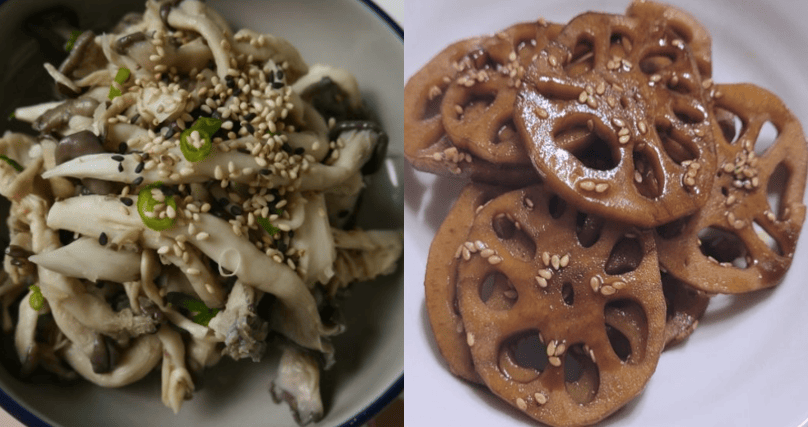
Beoseot Namul – Yeongeun Jorim
Finally, winter is the time when the wisdom of preservation truly shines. In addition to Kimchi made during the Gimjang season, side dishes made from dried vegetables—such as Siraegi (dried radish greens) and Mumallaengi (dried radish strips)—serve as precious sources of vitamins during the cold months when fresh produce is scarce. Ultimately, enjoying these seasonal banchan is the most delicious way to savor the full cycle of Korea’s four distinct seasons in a single bite.

Siraegi – Mumallaengi Muchim
4. The Soul of Korean Home Cooking: Understanding Mit-banchan
As described in “2. A World of Variety: Categorizing Banchan by Cooking Styles,” there is a unique category within Korean side dishes called “Mit-banchan” (basic side dishes). Unlike those prepared to be eaten immediately, these are meticulously crafted to be stored and enjoyed over a long period. Mit-banchan is truly the flower of Korean food culture—a concentrated essence of our ancestors’ wisdom in their quest to keep ingredients fresh and flavorful for as long as possible.

Above all, Mit-banchan is infused with a deep love for one’s family. In a typical Korean household, while these long-lasting side dishes serve as a reliable foundation, the main course, soup, or stew changes daily to keep the meal fresh.
When children living away from home visit for the weekend, it is a common sight to see a mother packing a large bundle of homemade Mit-banchan for them to take back. Within these containers lies a mother’s heartfelt wish: the hope that her child will never skip a meal and will always eat well, even when far from home. In this sense, Mit-banchan is more than just food—it is a mother’s warm embrace in edible form.

A mother’s heart—preparing everything in advance so her family can enjoy a warm meal at any time, even in the midst of a busy life—is vividly expressed through the containers of Mit-banchan that stoutly fill the refrigerator. In a Korean home, these are symbols of peace and abundance. Whether you are dining at a restaurant during your travels or eating at a local home, please remember that these small plates of banchan are, in fact, precious gifts completed by someone’s long hours and sincere devotion.

5. Conclusion: The Korean Table—Always Better When Shared
More than just food to fill the stomach, banchan is the essence of Korean philosophy and consideration for others. Each small plate on the table embodies the keen eye for choosing seasonal ingredients, the patience of waiting for flavors to mature, and the sincere devotion of wishing for someone’s health.
To our fellow travelers: when you visit a restaurant in Korea, don’t hesitate if you find a dish you love! Raise your hand and try calling out, “Imonim! (a friendly term for restaurant staff) More banchan, please!” You will find that they will gladly refill your plates with generous hospitality and care.

If you experience the warm gesture of a server silently refilling your empty plates, take it as “Jeong (情)”—the very heart and soul of Korea. I hope your journey through Korea is as rich and colorful as these diverse side dishes, and remains a memory as warm as the shared heat of a communal table.

FindYourKorea #KoreanFoodCulture #Banchan #KoreanSideDishes #Jeong #KoreanHospitality #KFood #KoreanTable #AuthenticKorea #HealthyEating #VeganFriendly #PlantBasedKorea #KoreanVegan #Temple Food #SlowFood #FermentedFood #HealthyLifestyle #VeggieSideDishes #Muchim #Jorim #Bokkeum #SeasonedVegetables #KoreanCooking #HomeCooking #FoodTravelKorea #KoreaTrip #SeoulFood