

The Hidden Soul of Korean Food, “Jang”
Do you remember the spicy charm of the Bibimbap you tasted during your trip to Korea, enhanced by Gochujang, or the savory aroma of a bubbling pot of Doenjang-jjigae? While many foreigners marvel at the taste of Korean food, not many know exactly where that flavor begins. To truly understand this, one must discover the “secret” hidden within Korean cuisine.

Bibimbap

Doenjang-jjigae
The secret of Korean cuisine lies in “Jang.” While salt and pepper provide the basic seasoning in Western cooking, “Jang” breathes soul into Korean dishes while adding a profound depth of flavor.
“Jang” is much more than just a seasoning made from fermented soybeans. It is an “Art of Time and Taste” created by the scorching summer sun, the chilly winter winds, and months to years of patient waiting. The process of boiling soybeans to make Meju (fermented soybean blocks) and letting microorganisms breathe inside Onggi (traditional earthenware jars) is a unique way Koreans communicate with nature.
The reason K-food is gaining global attention as a health food today is thanks to the beneficial fermented ingredients found in “Jang.” Now, I would like to share the mysterious story of “Jang”—the invisible protagonist of the Korean table that permeates every dish, concentrated with the life and wisdom of the Korean people.
1. Meju: A Masterpiece Crafted by Time and Nature
The very first ingredient that determines the deep flavor of Korean “Jang” is “Meju.” Meju is the foundation of fermentation, made by thoroughly boiling ripe yellow soybeans, pounding them in a mortar, and then shaping them into firm, brick-like blocks. It serves as the essential base for all types of Korean fermented pastes.
Meju
Just as Western cheese begins with curds, all Korean “Jang” starts with Meju. However, what makes Meju truly special is that its production involves the “realm of nature,” which is beyond human control. No matter how superior a person’s skill may be, it is ultimately nature that decides the final flavor.
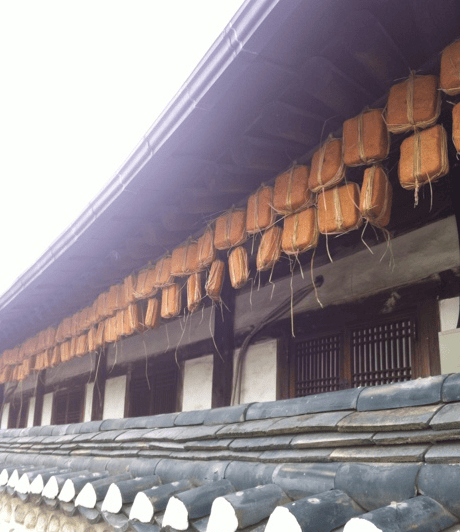
The carefully shaped Meju is tied with rice straw and either hung under the eaves of the house or placed in a warm room (specifically the Araetmok, the warmest part of the traditional Ondol heating system). During this time, beneficial microorganisms living in the rice straw permeate the Meju to aid in fermentation. The chilly winter winds properly dry the Meju, while the warm sunlight condenses the nutrients within.

Meju in a warm room
The pungent aroma of Meju might feel somewhat unfamiliar to foreigners encountering it for the first time. However, this scent is a “fragrance and a sign of healthy transformation” created solely by soybeans, nature, and time, without any artificial additives. Watching Meju dry through nature over several months allows one to glimpse the Korean philosophy that food is not merely “made,” but rather “crafted through waiting.”
The process by which these rugged blocks of soybeans are reborn as Doenjang and Ganjang—the cornerstones of the Korean table—can be described as a magnificent masterpiece co-created by nature and humanity.


2. The Essential Three: Korea’s Iconic Fermented Pastes
Once the fermentation of Meju is complete, it is finally time for it to transform into the three essential sauces that dominate the Korean table. To truly understand Korean cuisine, you must get to know these “Big Three.”
1) Doenjang (Soybean Paste): The Soulful Heart of Savory Flavor
Doenjang is created by soaking fermented Meju in brine, then separating and mashing the solids. Much like Western cheese, Doenjang possesses a strong, complex profile and is a nutritional powerhouse—rich in protein and easy to digest. It is the star ingredient of “Doenjang-jjigae” (soybean paste stew), a dish most beloved by Koreans. It effectively removes gamey odors from meat and adds a profound umami depth to any dish. (For instance, adding a spoonful of Doenjang when boiling meat for dishes like Suyuk or Bossam is the secret to neutralizing meat odors.)

Meju in salted water

Making Doenjang
2) Ganjang (Soy Sauce): The “Liquid Diamond” and Foundation of All Dishes
Ganjang is the dark, rich liquid extracted from fermented Meju. After the Meju blocks are removed from the aging jars, the remaining liquid is collected and filtered to remove impurities. This liquid is then gently simmered for 1 to 2 hours—a crucial step to prevent spoilage and develop its intense, deep aroma. After cooling, it is returned to jars to age and mature before use.
Far from being just “salty,” high-quality Ganjang is characterized by a complex profile of flavors and natural sweetness developed through long-term fermentation. In fact, well-aged, premium soy sauce is less salty and instead offers a subtle sweetness that elevates the flavor of any dish. It is no exaggeration to say that almost no Korean dish exists without it—from Bulgogi marinades and seasoned vegetables (Namul) to simple dipping sauces. It is a traditional sauce beloved not only in Korea but across many cultures worldwide.

MakingSoy Source
3) Gochujang (Chili Paste): The “Red Magic” Representing Korean Spice
Made by fermenting a blend of Meju powder, chili powder, glutinous rice flour, and malt, Gochujang is the ultimate symbol of Korean spice. It is not just about heat; the fermentation process creates a harmonious balance of subtle sweetness and deep, savory undertones. This is where the magic of the iconic “red sauce” in world-renowned K-foods—such as Bibimbap, Tteokbokki, and Jeyuk-bokkeum (spicy pork)—truly begins.

Making Gochujang
While these three sauces each possess their own unique charm, they all share a common origin: the single root known as “Meju.” Depending on how these pastes are combined and layered, thousands of different flavors are brought to life in Korean cuisine.
3. Jangdokdae: The Secret of the “Breathing” Onggi Jars
If you visit a traditional Hanok house or a temple during your trip to Korea, you will find jars of various sizes gathered together in a sunny corner of the courtyard. This place is “Jangdokdae,” the treasure warehouse where the authentic flavors of Korea are aged to perfection.

We call the jars placed here “Onggi.” These earthenware jars possess a unique scientific characteristic found nowhere else in the world: “Onggi breathes.” The clay used to make Onggi contains countless microscopic pores invisible to the naked eye. These pores are smaller than water molecules, preventing the contents from leaking, yet they allow air to flow freely. This enables the natural wind to circulate in and out of the jar as it pleases.

Thanks to this air permeability, the sauces inside can ferment for a long time without spoiling. This is because the microorganisms within the Onggi receive a steady supply of fresh oxygen, allowing them to remain active. For this reason, Koreans consider Onggi to be more than just a container; they see it as a “living vessel.”
Furthermore, the Jangdokdae is a space that makes the best use of Korea’s four seasons. When it rains, the lids are closed to keep out moisture, and on clear days, they are opened to let the sunlight and wind provide natural sterilization. Since the devotion shown in keeping the Jangdokdae clean was believed to directly affect the family’s food flavor, it was one of the most sacred and important places for Korean mothers.
The neatly arranged Jangdokdae not only offers a quintessential Korean landscape but also beautifully demonstrates the eco-friendly wisdom of Koreans, who store and age food relying solely on the power of nature without any artificial aid.

4. Slow Food for the Body and Soul: The Health Benefits
The most significant characteristic of Korean cuisine is the “science of fermentation.” The primary reason the entire world is paying attention to Korean Kimchi and Jang is the remarkable health benefits produced by this incredible fermentation science. In today’s world dominated by fast food, Korean Jang—aged over months and even years—embodies the true value of “Slow Food,” crafted through patience and waiting.
First, Jang contains the magic of fermentation. In the process of fermenting soybeans, the main ingredient, beneficial components that didn’t exist before are newly created. In particular, Doenjang and Gochujang are rich in probiotics and enzymes that aid digestion and strengthen gut health. They act as natural supplements that boost your immune system.

Second, it is a treasure trove of plant-based protein. Since it is made from soybeans, often called “beef from the field,” it serves as an excellent protein source for vegans. Through fermentation, the soybean proteins are broken down into a form that is much easier for our bodies to absorb. This can be seen as an advanced nutritional design rooted in the wisdom of our ancestors.

Lastly, Jang acts as a natural seasoning. It adds a deep umami flavor to dishes without any chemical additives, making a healthy diet possible by reducing salt intake while enhancing flavor.
Korean Jang goes beyond simply filling the stomach; it heals the body and recharges your energy. This is the secret to how many Koreans have maintained their health for so long, and it is the very reason why Jang is a must-have for your table as well.
5. Conclusion: A Mother’s Touch and the Spirit of “Jeong”
In Korea, there is an old saying: “When the taste of Jang changes, the fortune of the household changes.” This reflects how managing and caring for Jang was considered one of the most significant tasks of a family. Within that process lies a mother’s profound devotion, praying for the health and well-being of her loved ones.
In Korea, people often say, “Food is all about the Son-mat (the taste of one’s hands).” This doesn’t refer to mere manual skill. Rather, it is a uniquely Korean belief that even with the same ingredients, the flavor changes depending on the mindset and sincerity of the person preparing it. The secret behind the profound depth of Korean food is the heart that diligently wipes the Jangdokdae every morning and opens or closes the lids according to the weather.

Furthermore, “Jang” symbolizes the culture of sharing known as “Jeong (情).” Koreans have long built bonds and shared well wishes by dividing their well-aged Jang with neighbors. Even in a small dish of soy sauce on the table, the history of a family and someone’s long, patient waiting are contained within.
Today, you can easily purchase Gochujang, Doenjang, and Ganjang at supermarkets (even abroad). However, if you remember the effort and devotion of the Korean ancestors who painstakingly crafted these from scratch, you will be able to experience a flavor that is far more delicious and meaningful.

Gochujang and Doenjang in supermarket
To all international travelers, when you enjoy a meal in Korea, please take a moment to reflect on the meaning of the “Jang” within your food. It is not merely a salty or spicy flavor; it is “condensed devotion”—a blend of Korean life, love, and harmony with nature that has been passed down for thousands of years.

I hope your journey through Korea becomes a time that leaves a deep and lasting impression, much like the profound flavor of “Jang.” I invite you to feel the heart of Korea—the spirit of “Jeong”—through its delicious food.
KFood #KoreanFood #Gochujang #Doenjang #Ganjang #Jang #Fermentation #SlowFood #HealthyFood #Koreancuisine #FindYourKorea #DiscoverKorea #ExploreKorea #KoreaTrip #KoreaTravel #TravelToKorea #KoreanCulture #CondensedDevotion #ArtOfWaiting #KoreanWisdom #MotherTouch #AncientSecrets #SustainableFood #PlantBasedProtein #VeganKorea