
Why Do Koreans Value Dining Etiquette So Much?
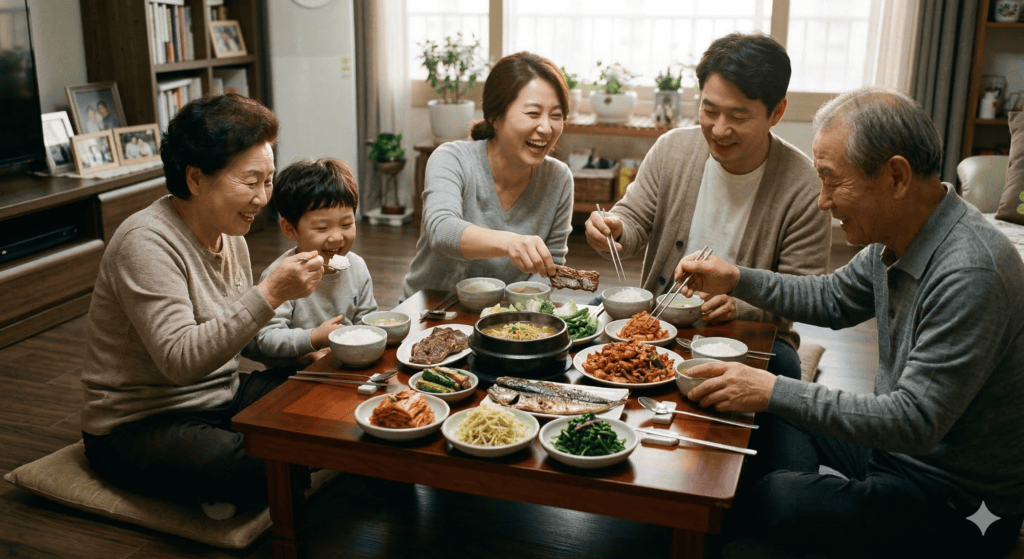
In Korea, the phrase “Have you eaten?” (Bap meogeonni?) is far more than a simple inquiry about one’s meal status. Within this short sentence lies a uniquely Korean sentiment—a way of checking on someone’s well-being and expressing affection. For the older generations who endured the Japanese colonial period, the Korean War, and the extreme poverty that followed, securing a single meal was a monumental task and a matter of direct survival.
As a result, “dining” in Korean culture transcends the mere act of eating for survival; it serves as the most essential social arena for building relationships and forming deep bonds between people.
Therefore, Korean dining etiquette is not just about “how to eat tidily.” It is a profound expression of “respect” and “consideration” for those sharing the table—especially for the parents who raised us and the elders who possess life’s wisdom. It also reflects a sense of relief, an unspoken acknowledgment that “we have survived another meal together.” Rooted in Confucian traditions, these manners have long served as invisible promises that hold the community together.
For international visitors encountering Korean food for the first time, these rules might seem a bit complex or strict. However, once you understand that the heart of these rules is “putting others before yourself” and celebrating our shared resilience, you will find the Korean dining table to be one of the warmest and most welcoming spaces in the world.
1. Pre-Dining Etiquette: The Beauty of Patience and Care
On a Korean dining table, whether at home or in a restaurant, invisible acts of consideration begin the moment the meal is prepared. When sitting at a restaurant or being invited to someone’s home, simply waiting for the food to arrive is far from the Korean virtue of hospitality.
Instead, we prepare for the meal together. Taking spoons and chopsticks from the container at the side of the table and placing them neatly on a hygienic paper liner or tissue, or the small gesture of pouring water into someone else’s glass first—these are the “first acts of kindness” Koreans show to one another before a meal. Through these small gestures, one can truly see the dining etiquette that values and cares for others.
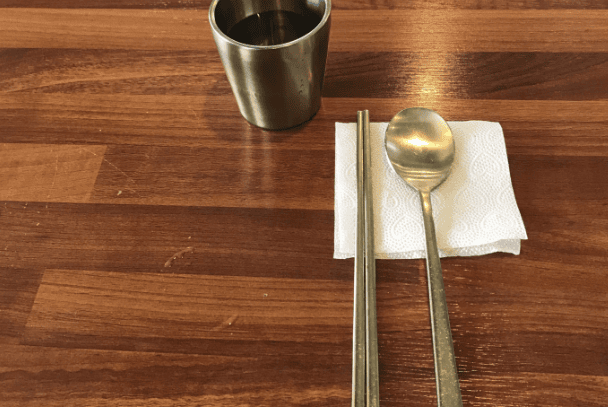

💡 Tip: In many Korean restaurants, you can typically find a built-in drawer on the side of the table (either on the left or right). Inside, you’ll find the spoons, chopsticks, and napkins conveniently tucked away.
Above all, the most crucial aspect of etiquette is “waiting.” Traditional Korean dining etiquette follows the principle of “elders first.” It is a sign of respect to wait for the oldest person at the table to lift their spoon and begin the meal first. Even if you are hungry, this brief moment of waiting out of respect for your elders symbolizes the generational order and the profound reverence that Korean society has long upheld.
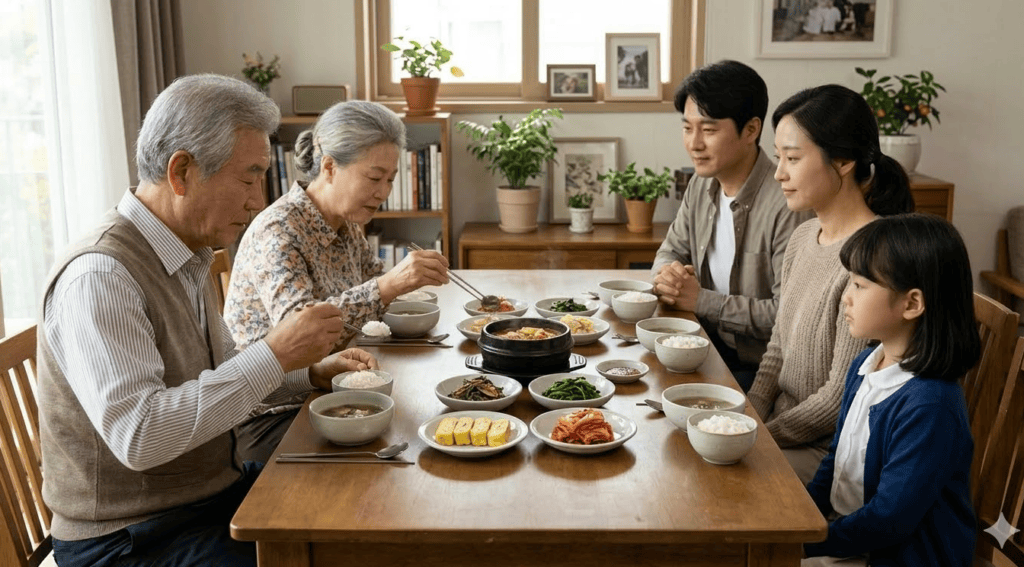
Finally, don’t forget to say “Jal-meok-ges-seub-ni-da” (I will eat well) to mark the beginning of the meal. This greeting is a sincere expression of gratitude toward the cook who prepared the food with care, the host who provided the meal, and everyone whose hard work allowed this food to reach the table.
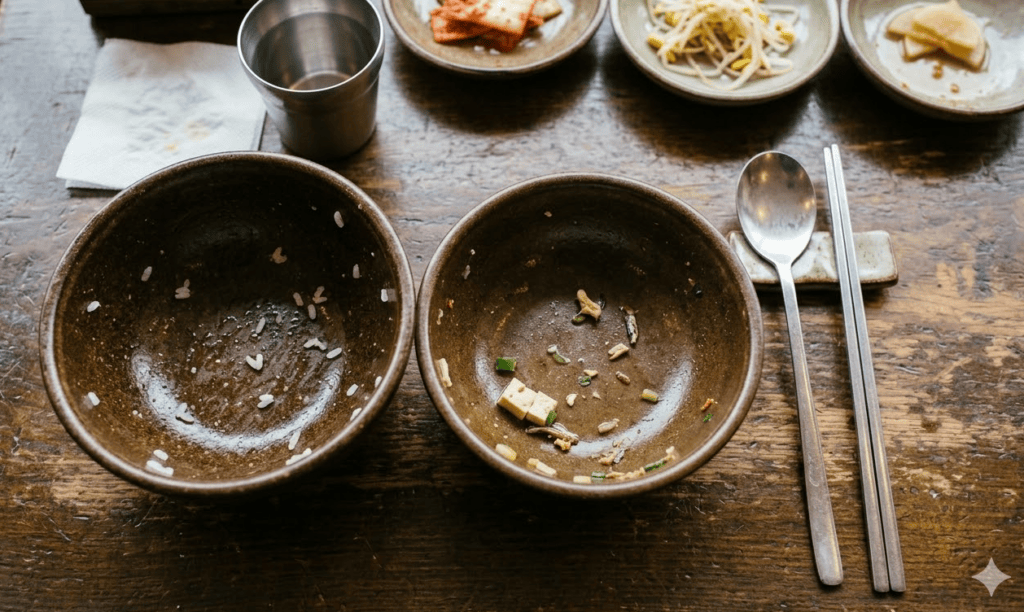
If you are invited to someone’s home, it is basic etiquette to move your used dishes (rice bowl, soup bowl, spoon, and chopsticks) to the kitchen sink once all have finished and start cleaning. When you attempt to do this, the host will almost certainly say, “It’s okay. Just leave it there.” Despite this, it is still considered polite to follow through and move them to the sink yourself.
2. During the Meal: Proper Use of Spoon and Chopsticks
One of the most distinctive features of Korean dining etiquette is the “Sujeo” culture, which involves using both a spoon and chopsticks. Much like the specific roles of a knife and fork in Western dining, each utensil has a clear purpose, and there are several important rules that must be followed.
First, there is the proper use of the spoon and chopsticks. It is considered impolite to hold both a spoon and chopsticks in one hand at the same time. You should use the spoon for soup or rice and chopsticks for side dishes, neatly placing the unused utensil back on the table. In particular, you must never stick your spoon upright into a bowl of rice. This act is reserved exclusively for ancestral rites (Jesa) to offer food to the deceased; therefore, it is strictly forbidden during a regular meal.
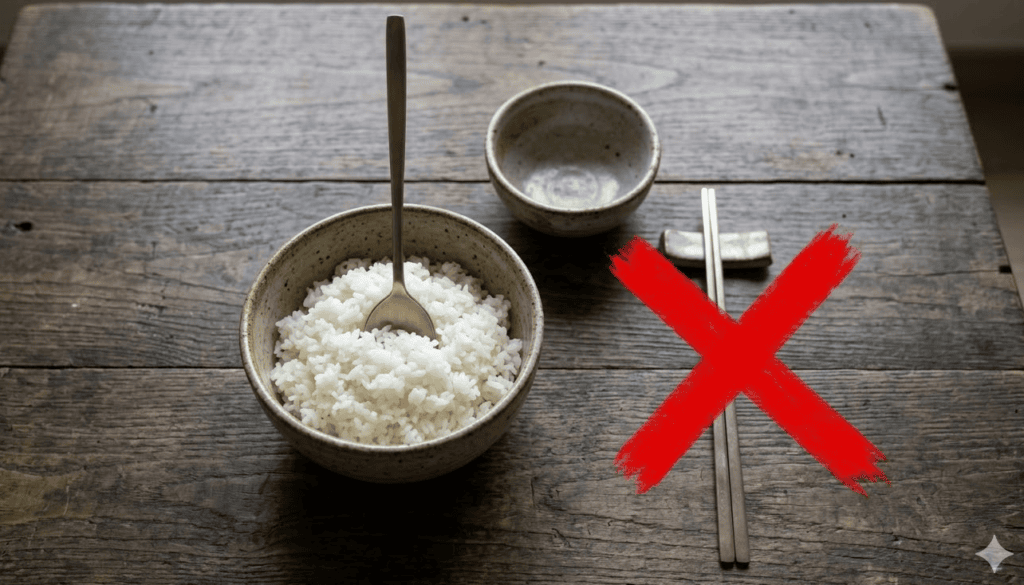
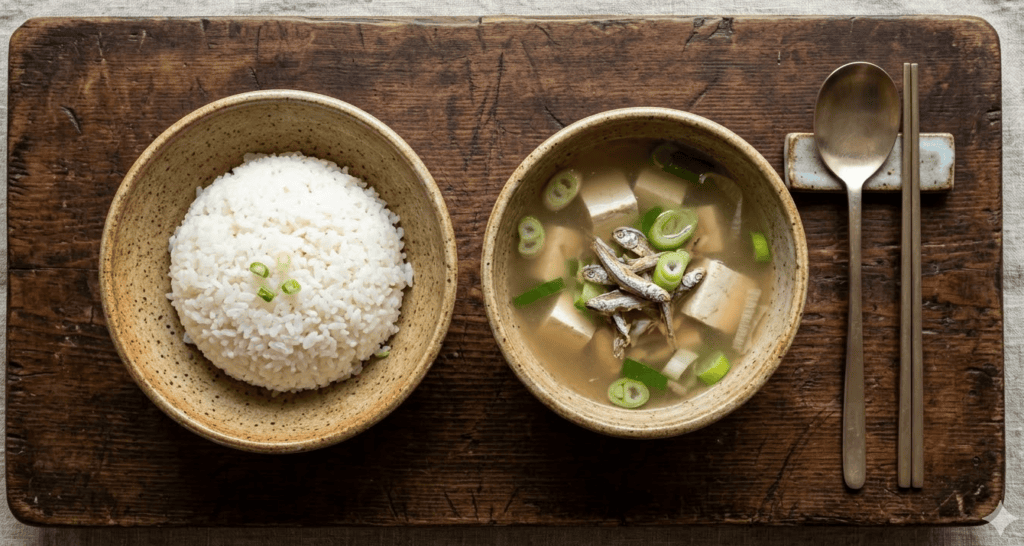
Second, “keep your rice bowl on the table.” While it is common in neighboring countries like China or Japan to hold the bowl in your hand while eating, in Korea, lifting the bowl is considered unrefined. This stems from the traditional belief that “the earth (the table) supports the bowl, and humans scoop up blessings from it.” Please respect this unique Korean style of using a spoon to eat your rice and soup., “keep your rice bowl on the table.” While it is common in neighboring countries like China or Japan to hold the bowl in your hand while eating, in Korea, lifting the bowl is considered unrefined. This stems from the traditional belief that “the earth (the table) supports the bowl, and humans scoop up blessings from it.” Please respect this unique Korean style of using a spoon to eat your rice and soup.
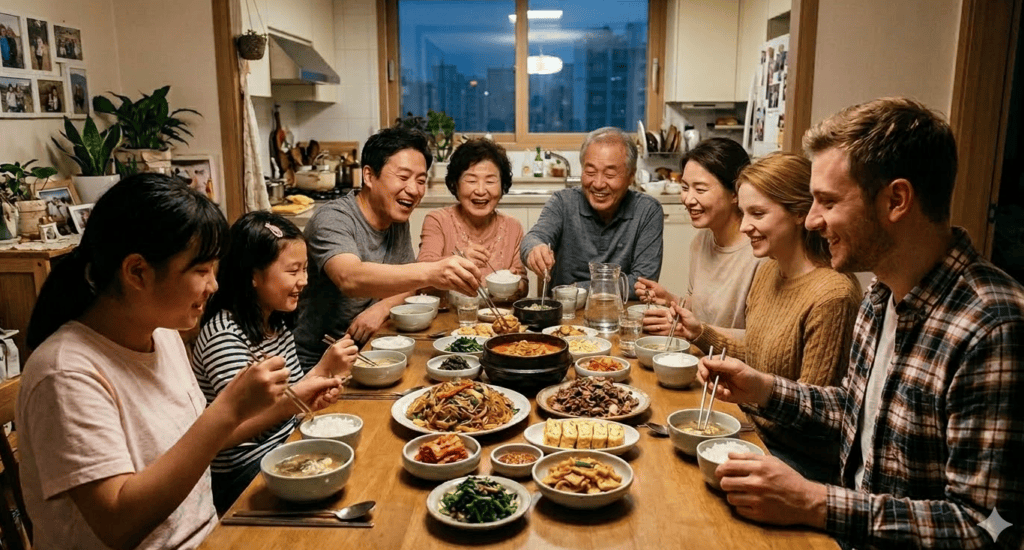
Third, hygiene and consideration. Korea has a well-developed “sharing” culture where stews (Jjigae) or hot pots (Jeongol) are shared among everyone at the table. While it was once common in homes to eat directly from a shared pot with one’s own spoon, the culture has evolved. For hygiene reasons, it is now standard practice to use a ladle to serve portions into individual small plates (Ap-jeopsi).
When serving yourself, it is considered impolite to rummage through the pot to find specific ingredients or to pick out only the “best” parts. Furthermore, true Korean table manners are perfected by matching your eating pace with those around you, ensuring that everyone enjoys the meal together.
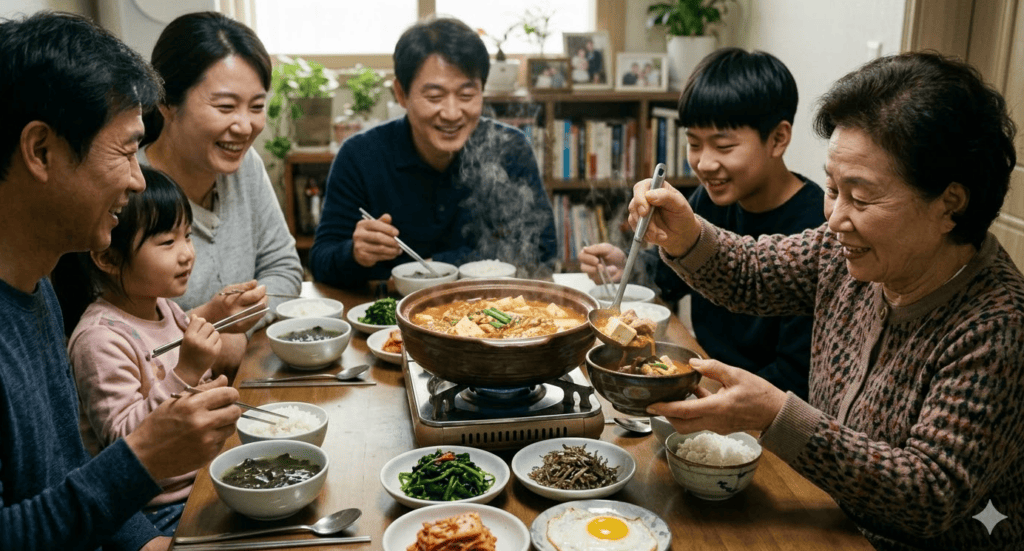
Finally, please remember to minimize any clinking sounds of utensils against the dishes or the sound of chewing. A dining table where quiet, respectful manners harmonize with pleasant conversation is the most ideal dining scene that Koreans strive for.
3. Dining Etiquette: Drinking Manners and Conversation
A Korean meal truly becomes a complete social arena when accompanied by conversation and a drink. In particular, drinking etiquette is where Korean social hierarchy and respect for others are most intensely demonstrated. These manners are often seen as a reflection of one’s upbringing and character; in fact, people may even draw conclusions about a person’s personality based on their behavior during a drinking session.
The first thing to remember is the “Magic of Two Hands.” Whether pouring or receiving a drink, using both hands is the fundamental rule. When pouring, hold the bottle with your right hand and lightly support it with your left to show sincerity. When receiving a drink, wrap both hands around the glass to express your gratitude. These gestures are a way of showing that you value the other person and are treating them with the utmost respect.
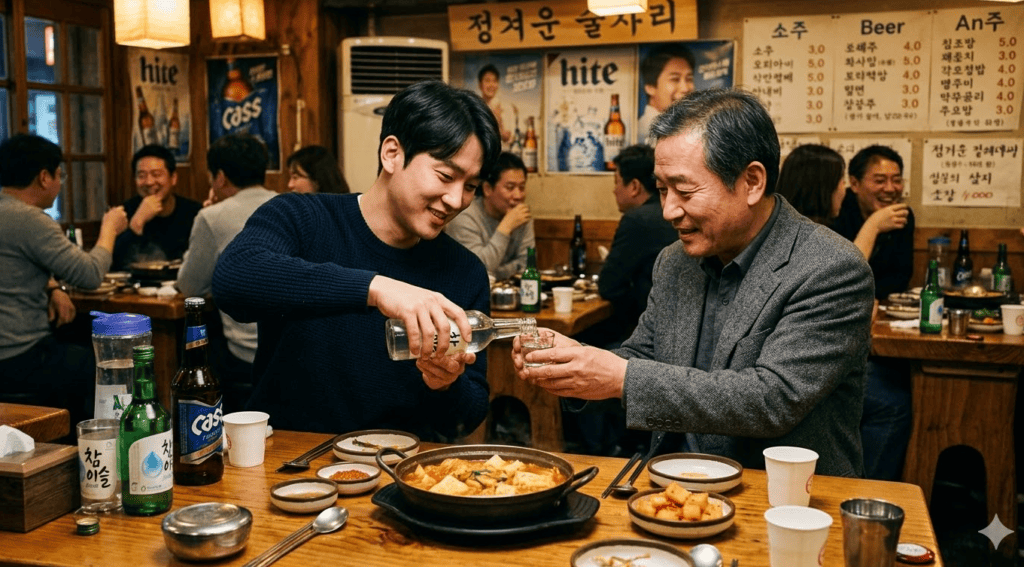
The “angle” at which you drink is also a crucial part of etiquette. When drinking with elders or superiors, it is polite to turn your head slightly away and cover your glass with your hands rather than drinking while facing them directly. This is an expression of humility, showing that you are being careful not to drink “in front of” an elder.
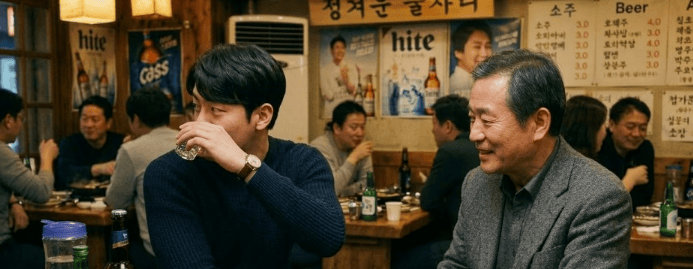
Additionally, keeping an eye on others’ glasses is important; if you see an empty glass, it is polite to refill it first. In a shared social setting, pouring your own drink is considered impolite. This act is called “Jajak” (self-pouring). Instead, the culture of sharing affection by filling each other’s glasses is what makes Korean drinking sessions so much richer. Furthermore, when drinking with elders, it is proper to wait for the elder to propose the first toast before you begin.
Finally, consider the “pace of conversation.” While the Korean dining table is a place for lively and joyful discussion, you should avoid speaking with your mouth full of food. Additionally, be careful not to let your voice become too loud in the excitement of the moment. It is important to adjust your eating speed to stay in sync with those around you.
The true essence of “dining conversation” that Koreans pursue is not merely about filling one’s stomach; it is about listening attentively to each other and “aligning the pace of our hearts.”
4. Conclusion: The Heart of Etiquette is “Respect for Others”
Korea has long been known as the “Land of Courteous People in the East”—a name that reflects how deeply we value mutual respect. For those unfamiliar with Korean culture, the sheer number of social etiquettes may feel a bit overwhelming at first.
The dining manners we have explored today might also feel like a complex list of homework. However, there is one core principle that flows through all these rules: “Deep respect for the person sitting across from you.”
Waiting for an elder to pick up their spoon is a way of honoring them and paying tribute to the wisdom they have gained through life. Neatly setting the table or pouring water is a physical gesture showing that the time spent sharing this meal is precious to you. In essence, Korean table manners are not mere formalities; they are the warmest form of communication—a way of caring for and considering one another’s hearts within the small space of a dining table.
As a foreign traveler, do not worry if you cannot follow every rule perfectly. On the contrary, Koreans find the very effort of a foreign friend trying to learn our etiquette to be beautiful and deeply appreciated, even if it’s a bit clumsy. Even if you make a mistake, a sincere greeting with a bright smile—“Jal-meok-ges-seub-ni-da” (I will eat well) or “Jal-meok-at-seub-ni-da” (I ate well)—is more than enough.
The warm gazes and considerate actions shared over a meal are the “most delicious seasonings” of all. I hope your journey in Korea is not just about tasting great food, but a precious time where you can deeply feel the culture of “Jeong” (affection) and mutual respect.
KoreanEtiquette #KoreanDining #RespectCulture #AsianManners #KoreanTableManners #DiningGuide #HowToEatInKorea #KoreanChopsticks #SujeoCulture #DrinkingEtiquette #FindYourKorea #ExperienceKorea #KoreanCultureGuide #KoreaTravelTips